



Controlled reactivity for 1K adhesive systems
In industrial adhesive formulation, isocyanate reactivity is a performance lever and a handling constraint at the same time. Free isocyanate functionality can increase crosslink density, cohesive strength, heat resistance, hydrolysis resistance and chemical resistance. The same reactivity can also reduce pot life, increase moisture sensitivity and complicate storage, filling and application.
Latent crosslinking addresses this conflict by separating application viscosity and storage stability from final network formation. The adhesive is formulated, transported, coated and assembled as a one-component system. Crosslinking is then initiated by a defined process input, most commonly heat and dwell time after film formation or during a subsequent bonding step.
For adhesive producers and in-house formulators, this is the central value proposition: one-component processing with two-component-like final resistance, provided that the activation profile is correctly matched to the binder, substrate and manufacturing process.
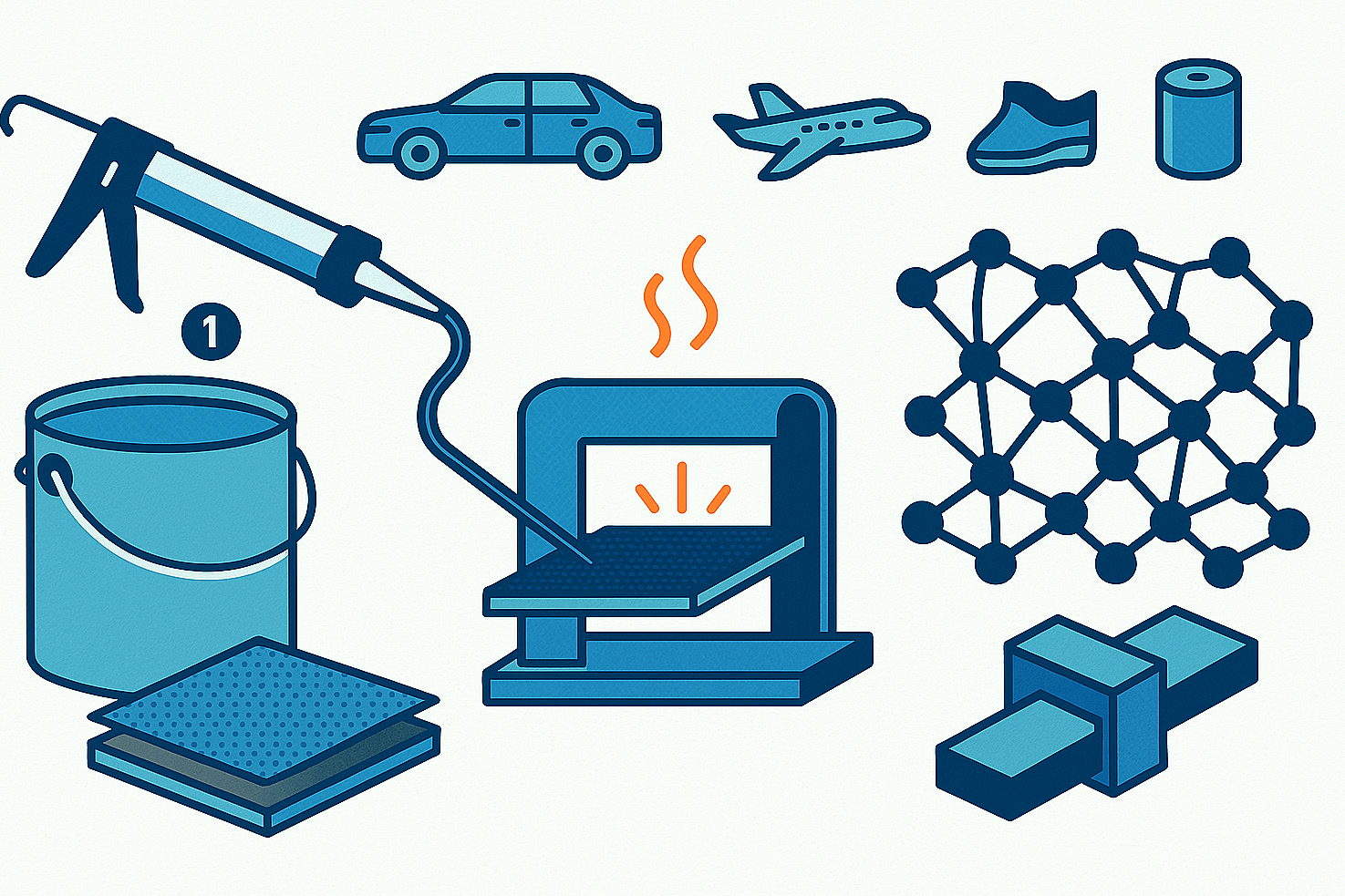
Blocked isocyanates: reaction potential held in reserve
A blocked isocyanate contains isocyanate functionality that is temporarily masked or incorporated into a thermally reversible structure. At ambient conditions it is substantially less reactive toward water, alcohols, amines and other nucleophiles than a free polyisocyanate. Under suitable activation conditions, reactive isocyanate functionality is regenerated or made available for reaction with hydroxyl, amine, urethane, urea or other active-hydrogen sites in the binder phase or at the substrate interface.
The practical deblocking temperature is not a fixed material constant. Technical literature on blocked isocyanates shows that the apparent activation point depends on the isocyanate backbone, blocking group, catalyst package, resin matrix, film thickness, heating rate, volatility or retention of the blocking agent, and the analytical method used. DSC, TGA, hot-stage FTIR, DMA and application testing can all describe different aspects of the same chemistry.
For adhesive development, the relevant value is therefore not an isolated laboratory deblocking number. It is the temperature/time/pressure window in which the adhesive film develops the required conversion, cohesive strength and interfacial adhesion under production conditions.
IsoQure TT: TDI dimer for latent crosslinking
IsoQure TT is a TDI dimer used as a latent crosslinker for one-component aqueous adhesion systems, hotmelts, reactive sealants, coatings, adhesives and elastomers. It combines latency during compounding and application with high final crosslink density after activation.
The dimer structure is especially relevant where the adhesive system must remain stable before use but develop stronger polymer-network performance during heat activation. In suitable formulations, IsoQure TT enhances adhesion to polyester, PVC and rubber substrates and improves heat and hydrolysis resistance in conveyor belt, coated fabric, rubber-to-fabric and related technical-textile applications.
Its value is formulation-dependent. Binder chemistry, particle size or dispersion behavior, catalyst selection, drying profile, activation temperature, substrate pretreatment and aging tests all determine whether the latent crosslinker is contributing to the final bond line.
Why 1K systems matter to adhesive producers
Many Kautschuk customers formulate adhesives for downstream industrial users, or operate internal adhesive and coating technologies for their own assemblies. For these customers, one-component systems reduce process risk and simplify implementation.
Relevant advantages include:
- elimination of on-line mixing of two reactive components;
- reduced metering error and fewer pot-life limitations at the application station;
- suitability for automated coating, spraying, dipping, calendering, laminating or pre-application;
- compatibility with heat-activated films, coated substrates and pre-bonded intermediate goods;
- simplified packaging, inventory and batch-control procedures;
- activation in a controlled manufacturing step where temperature, pressure and dwell time can be specified.
The formulator's task is to convert these operational advantages into a reliable product specification: stable before activation, reactive during activation, and resistant after activation.
Blocking chemistry as formulation architecture
The blocked-isocyanate family is not one technology but a set of design options. Caprolactam-, oxime-, pyrazole-, malonate- and uretdione/dimer-based systems differ in activation range, volatility, blocking-agent residue, yellowing tendency, compatibility, viscosity, water dispersibility and cure response.
Technical guidance from the broader blocked-isocyanate industry repeatedly frames selection around process temperature and substrate tolerance. Lower activation temperature can reduce energy demand and dwell time, but must still provide storage stability. Higher latency can improve handling robustness, but only if the customer can deliver enough heat into the adhesive layer without damaging the substrate.
Solvent-borne stoving systems, waterborne 1K dispersions, hotmelts, reactive sealants and elastomer systems each impose different constraints. A blocked crosslinker for a textile coating does not face the same requirements as a structural adhesive film, a rubber-to-cord treatment, or an automotive trim adhesive.
Established application areas
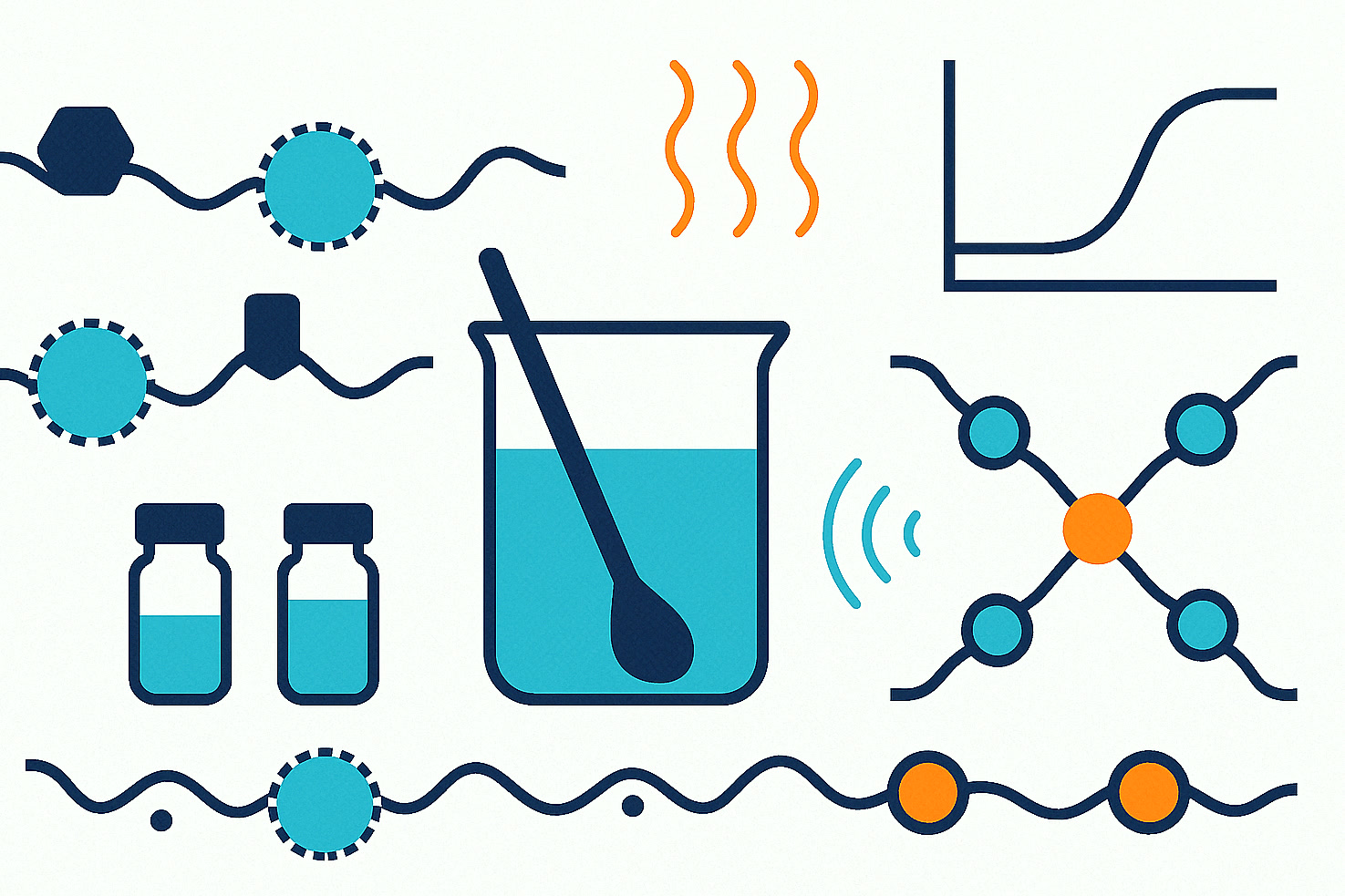
Blocked and latent isocyanates have a long industrial history in coatings, binders, adhesives and elastomers. In adhesive technology they are most useful when the uncured product must remain processable, while the cured bond must resist heat, moisture, solvents, plasticizers or mechanical fatigue.
Important application areas include:
- Rubber-to-fabric bonding: adhesion of rubber compounds to polyester, aramid or polyamide reinforcement in conveyor belts, drive belts, hoses, rollers, coated fabrics and technical textiles.
- PVC-to-fabric bonding: flexible laminates, lightweight conveyor belts, tarpaulins and coated textiles where hydrolysis resistance, washout resistance and adhesion retention are required.
- Automotive assemblies: interior trim, exterior profiles, coated textile elements, foams, seals and heat-activated adhesive layers where 1K handling simplifies series production.
- Aerospace and transportation: specialty laminates, flexible composites, adhesive films and coatings where controlled cure and storage stability are part of the qualification strategy.
- Consumer goods: footwear, sports equipment, luggage, apparel components and flexible assemblies exposed to bending, cleaning, oils, perspiration and heat.
- Structural and semi-structural bonding: pre-applied adhesives, heat-activated films and assembly processes where bond formation is intentionally delayed until a defined manufacturing step.
Waterborne latent systems require formulation discipline
Waterborne 1K systems are attractive because they support lower solvent emissions and simpler handling, but they are technically demanding. A latent isocyanate crosslinker must remain compatible with the dispersion, avoid hard settling, tolerate the pH and surfactant environment, and remain sufficiently available after drying to participate in network formation.
Recent waterborne blocked-isocyanate work highlights the same development issue encountered in production: chemical suitability alone is not enough. Emulsion stability, secondary emulsification, particle size, coalescence, filler interactions, drying temperature and activation schedule determine whether the crosslinker produces useful performance in the finished film.
For adhesive producers, the development target is a complete system: polymer dispersion, crosslinker, additives, substrate wetting, drying profile, activation profile and final aging resistance.
Development questions before scale-up
A professional latent-crosslinking program should define the process and performance envelope before plant trials. Key questions include:
- Activation profile: required temperature, dwell time, pressure and heat transfer into the bond line.
- Substrate tolerance: thermal stability of rubber, PVC, fabric, foam, coating, composite or primer layers.
- Film formation: wetting, drying, coalescence, melt flow or tack development before crosslinking restricts mobility.
- Reaction partners: availability of hydroxyl, amine, urethane, urea or other active-hydrogen sites in the binder or interface.
- Catalysis: catalyst type, latency, hydrolytic stability and influence on one-component storage life.
- Storage stability: viscosity drift, sedimentation, re-dispersibility, premature reaction, packaging compatibility and retained activation response.
- Final performance: peel, shear, cohesive failure mode, heat aging, humidity exposure, hydrolysis resistance, flex fatigue, plasticizer resistance and solvent resistance.
These criteria are more meaningful than a generic statement that a crosslinker is “reactive”. In latent systems, the decisive question is whether the reaction occurs at the correct point in the process and produces the required bond-line morphology.

Processing window as a product specification
For an adhesive producer, the processing window is not merely a convenience. It is part of the commercial product specification. The adhesive must tolerate manufacture, filtration, filling, transport, storage, customer handling and application without unacceptable viscosity drift, sedimentation, skinning, premature gelation or loss of activation response.
IsoQure TT and other blocked isocyanates should therefore be screened under realistic conditions: storage at relevant temperatures, repeated opening and closing where applicable, shear during coating, drying behavior, open time, blocking resistance, reactivation after storage, and compatibility with the customer's equipment.
A system that reacts too early can fail before its final performance is ever measured. A system that reacts too late may pass storage tests but fail the customer's production cycle.
Final performance after activation
After activation, the crosslinker must demonstrate measurable value. In rubber-to-fabric bonding this may be peel retention after hot/wet aging and repeated flexing. In automotive assemblies it may be adhesion retention after climate cycling, plasticizer exposure, thermal load or cleaning-agent contact. In aerospace and transportation it may be durability in lightweight composite assemblies, adhesive films or specialty coatings. In consumer goods it may be flexible-bond retention after deformation, heat, perspiration, oils or repeated cleaning.
The objective is a controlled transition: Process as a stable 1K adhesive, activate under defined conditions, and deliver a crosslinked bond line with the resistance profile specified for the application.
Technical support for one-component adhesive development
Kautschuk Group supports adhesive producers and in-house formulators working with IsoQure TT and other isocyanate-based crosslinking systems. Product selection depends on binder chemistry, substrate, activation profile, target resistance, regulatory requirements and production constraints.
If you are developing one-component adhesives for automotive, aerospace, consumer goods, rubber-to-fabric bonding, coated textiles or structural applications, the discussion should begin with the process window and end with the performance tests that determine service life.