



A small addition with a large job
Automotive bonding is not simply a question of making two materials stick. The bond has to survive production handling, heat, humidity, movement, cleaning agents, oils and years of service. That is especially true when rigid glass, flexible rubber profiles and solvent-based adhesive systems meet in one assembly.
Isodur RFE is a solvent-based polyisocyanate crosslinker for polyurethane, natural rubber and synthetic rubber adhesive systems, especially chloroprene-rubber adhesives.
In the adhesive film, Isodur RFE increases crosslink density. It improves heat stability, hydrolysis resistance and resistance to greases, oils and solvents. For automotive applications, that combination is often more important than a single high initial-strength value.
Why glass-to-rubber bonding is demanding
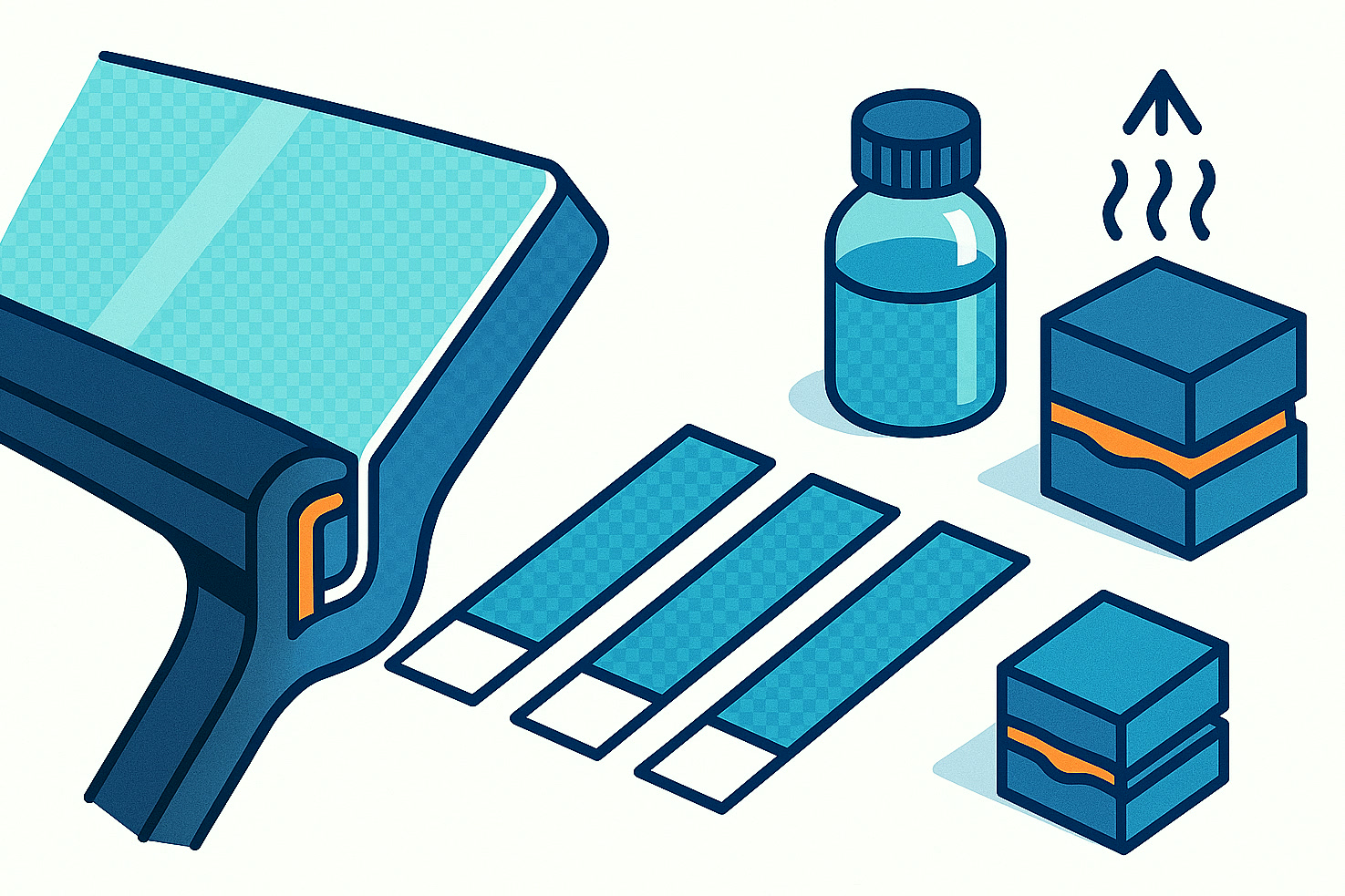
Automotive glazing and sealing systems bring together materials with very different behavior. Glass is rigid, dimensionally stable and sensitive to surface condition. Rubber profiles are elastic and can contain fillers, oils, waxes, pigments, plasticizers and processing aids. The adhesive has to bridge that difference while remaining flexible enough for movement and strong enough for handling and service.
In glass-to-rubber work, the weak point is often not the headline adhesive chemistry but the complete interface: cleaning, surface activation, primer choice, rubber formulation, adhesive dry time, pressure, temperature and the time allowed before the part is loaded. Isodur RFE does not replace those process controls. It makes a well-designed adhesive system more robust.
Typical areas where this chemistry is relevant include:
- bonding rubber profiles to fixed glass elements or glazing modules;
- attaching or reinforcing rubber sealing components in window, door and body assemblies;
- chloroprene-rubber-based contact adhesives where early handling strength and heat resistance matter;
- adhesive systems for trim, seals, profiles, coated textiles and flexible components exposed to oils, moisture or elevated temperatures;
- general high-stress rubber, PVC, EVA, leather or coated-material bonds where a stronger crosslinked adhesive film is required.
Every automotive application still needs its own qualification work. Substrate grade, rubber formulation, primer system, surface treatment, adhesive base polymer and process conditions all influence the final result.
What Isodur RFE contributes to the adhesive film
Polyisocyanate crosslinkers have a long history in solvent-based industrial adhesives because they convert a thermoplastic adhesive film into a more resistant network. Isodur RFE is used when the adhesive film must keep performance after drying, pressing, aging and exposure.
For formulators and process engineers, the relevant effects are concrete:
- Higher heat resistance for bonds exposed to warm assembly conditions, sun load or elevated service temperatures.
- Improved humidity and hydrolysis resistance where condensation, water exposure or climate cycling can weaken less robust adhesive films.
- Better resistance to oils, greases, plasticizers and solvents in automotive and industrial environments.
- Improved cohesion of the adhesive layer so the bond line is less likely to fail inside the film under peel, shear or flexing stress.
- Stronger performance in contact adhesives based on polyurethane or rubber polymers, including chloroprene systems.
- Broad substrate relevance in adhesive systems used with rubber, PVC, EVA, leather, coated fabrics and related flexible materials.
The purpose is not simply to make a laboratory number look better. The purpose is to make the bond more predictable after drying, pressing, early handling, heat aging and exposure to real service conditions.
Industrial guidance: look at the complete bond line
Historical technical guidance for this type of crosslinker is consistent on one point: the result depends on the whole adhesive system, not only on the additive. Isodur RFE should be evaluated together with the base polymer, solvent blend, resin package, substrate condition and production method.
For automotive glass-to-rubber and related assemblies, useful checks include:
- Surface state: glass cleaning, ceramic frit or coating compatibility, primer choice and rubber surface preparation.
- Adhesive film formation: coating weight, solvent flash-off, open time, dry time and pressure during joining.
- Failure mode: whether failure is adhesive at the glass, adhesive at the rubber, cohesive inside the adhesive layer or cohesive in the rubber itself.
- Aging resistance: peel and shear performance after heat aging, humidity storage, water exposure and climate cycling.
- Chemical exposure: resistance against oils, greases, plasticizers, cleaners or other substances relevant to the assembly.
- Production rhythm: pot life, batch size, mixing quality and whether the activated adhesive remains usable for the planned shift or operation.
These questions are practical because Isodur RFE changes both final resistance and processing behavior. A good formulation has to deliver performance without creating an unrealistic production window.
Processing reality: pot life matters
Isodur RFE is reactive. After it is added to a polyurethane- or rubber-based adhesive, the mixture must be used within its pot life. Depending on polymer content, moisture exposure, temperature and formulation ingredients such as resins, antioxidants, plasticizers, fillers and solvents, the workable period is normally established by the formulator through application testing rather than treated as a fixed product constant.
For production, this is a planning point, not a footnote. The crosslinker should be dosed and mixed in a controlled way, with realistic batch sizes, clean containers and clear handling instructions. Moisture should be controlled because isocyanates react with water. Containers should be closed promptly after use, and activated adhesive should not be treated as if it were the original one-component adhesive.
The best technical result comes when the adhesive chemistry and the production rhythm are designed together.
Where we see the strongest fit
Isodur RFE is most valuable where the bond line has to do real work: holding flexible substrates, resisting heat or moisture, tolerating oils or plasticizers, or maintaining adhesion after early mechanical stress. Automotive glass-to-rubber bonding is a good example because the interface is functional, visible and exposed to daily movement and weathering.
It can also be considered for other demanding adhesive applications in transportation, footwear, coated textiles and industrial flexible-material assemblies. The common theme is not the market label; it is the requirement profile: adhesion, flexibility, chemical resistance and process reliability in one system.
Technical support for qualification
A product highlight can only point to the opportunity. The final decision belongs in application testing. Kautschuk Group can support discussions on suitable adhesive systems, dosage windows, pot-life expectations, handling, packaging and regional supply.
For customers working on automotive glass-to-rubber bonding or related rubber and flexible-material assemblies, Isodur RFE is a compact but powerful tool in the formulation toolbox.